

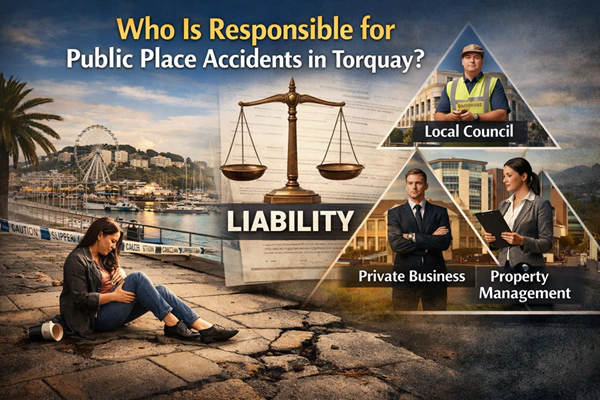
When an accident happens in a public place, responsibility is rarely obvious. In Torquay, people injured on pavements, in car parks, parks, leisure facilities, or shared access areas often assume there is no clear route to compensation because they do not know who was responsible for the space.
Public place accident claims are not about guessing or blaming the wrong organisation. They are about identifying who controlled the area at the time of the accident and whether reasonable steps were taken to keep it safe.
Understanding how responsibility is assessed can help you decide whether an injury was avoidable and whether taking action makes sense.
Why responsibility in public places is often unclear
Everyone uses public places, but not everyone manages them. Different organisations may own, manage, maintain, or guarantee the same space, sometimes under layered arrangements.
For example, a walkway may be owned by a local authority but maintained by a contractor. A car park may be attached to a retail site but operated by a separate management company. A leisure facility may be open to the public but privately run.
Because of this, responsibility is determined by control and duty, not by assumptions about ownership.
The legal duty behind public place safety
The organisation responsible for a public space has a legal obligation to take reasonable steps to keep it safe for visitors. This does not mean guaranteeing safety in all circumstances, but it does mean identifying foreseeable risks and managing them properly.
Reasonable steps often include regular inspections, timely repairs, clear signage where hazards exist, and systems for responding to reported issues. Public place accident claims focus on whether these systems were in place and followed in practice.
Common parties who may be responsible
In Torquay, responsibility for public spaces may rest with different bodies depending on the location.
Local councils are often responsible for pavements, roads, and public parks. Private companies may manage shopping centres, car parks, or leisure venues. Managing agents or housing associations may be responsible for communal areas in residential developments.
Identifying the correct party is a key early step and is not something an injured person is expected to know immediately.
When responsibility may be disputed
Not every accident in a public place leads to liability. Disputes often arise over how long a hazard existed, whether inspections were carried out properly, and whether the risk should reasonably have been identified and addressed.
For example, a defect that developed suddenly may not result in liability if there was no reasonable opportunity to repair it. A longstanding hazard that should have been identified through inspections may support a claim.
These cases turn on evidence rather than assumptions.
The role of evidence is crucial in establishing responsibility
Public place accident claims are evidence-driven. Photographs of the hazard, medical records, witness details, and incident reports can all help establish what happened.
Inspection and maintenance records are often central, particularly where councils or organisations conduct regular checks. These records help determine whether reasonable care was taken.
This is why reporting an accident and preserving details early can make a significant difference.
Shared responsibility and contributory negligence
In some cases, responsibility may be shared. If an injured person failed to take reasonable care for their safety, compensation may be reduced rather than refused entirely.
For example, ignoring clear warning signs or barriers may affect how responsibility is apportioned. Each case is assessed on its facts.
What happens once responsibility is established?
If responsibility is established, compensation may reflect pain and suffering, loss of earnings, medical treatment costs, travel expenses, and any on-going support required as a result of the injury.
The purpose of compensation is not to punish the organisation involved but to address the impact the injury has had on the injured person’s life.
Time limits still apply
Public place accident claims are subject to time limits, usually three years from the date of the accident. Delays can complicate claims, especially when hazards undergo repairs or records disappear.
Early advice helps clarify responsibility and protect your options.
How Marley Solicitors can help
Marley Solicitors provides advice to clients injured in public places in Torquay and throughout Devon. We help identify who may be responsible, assess whether safety duties were met, and explain your options clearly and realistically.
Our approach focuses on evidence, practicality, and helping you decide whether pursuing a claim is appropriate.
Understanding responsibility before deciding what to do
If you were injured in a public place in Torquay and are unsure who may be responsible, understanding how liability is assessed can provide clarity. Many people take no action simply because responsibility feels too complex to untangle.
Clear guidance early on can help you make an informed decision and avoid carrying the consequences of an avoidable accident alone.