

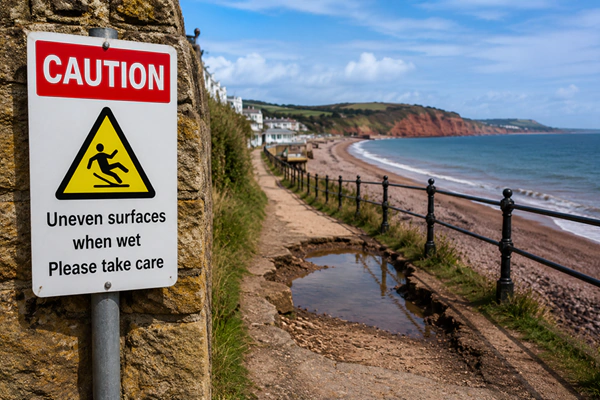
Exmouth’s beaches and coastal paths attract large numbers of visitors throughout the year. From the seafront promenade to more rugged walking routes along the coastline, these areas offer open access but also introduce unique risks. Changing tides, wet surfaces, uneven terrain and high foot traffic all contribute to accidents that occur without much warning.
When an incident happens in this type of environment, the key question is not simply what occurred, but whether it could have been prevented. Coastal areas are naturally unpredictable, but that does not remove responsibility where proper maintenance, safety measures or warnings should have been in place.
Understanding how these situations are assessed helps clarify whether a claim may be possible.
Coastal environments are not risk-free
Beaches and coastal paths are expected to carry some natural hazards. Wet sands, loose stones, and shifting surfaces are part of the environment. However, there is a clear distinction between natural risk and preventable danger.
If surfaces become hazardous due to neglect, lack of maintenance or failure to manage known risks, responsibility may arise. This is particularly relevant in maintained areas, such as promenades, designated walking routes, and access points.
Where accidents commonly occur in Exmouth
Certain locations present a higher likelihood of incidents, especially where conditions change quickly or where large numbers of people pass through.
- Slips on algae-covered surfaces near the waterline
- Trips on uneven or eroded coastal paths
- Falls on poorly maintained promenades
- Accidents caused by inadequate signage in hazardous areas
These situations often come down to whether the hazard was known, foreseeable and appropriately managed.
The difference between natural hazards and negligence
Not every accident on a beach or coastal path will lead to a valid claim. The distinction lies in whether reasonable steps were taken to reduce or highlight the risk.
For example, a naturally slippery rock surface may not in itself create liability. However, if a maintained walkway becomes dangerous due to a lack of cleaning, poor upkeep, or the absence of warning signs, the situation changes.
Responsibility depends on whether the risk went beyond what a person would reasonably expect in that environment.
Who may be responsible for coastal accidents?
Responsibility in coastal areas can vary depending on the exact location of the incident.
- Local authorities may be responsible for promenades, access paths and maintained areas
- Private operators may be responsible for specific sections, such as beach facilities or nearby businesses
- In some cases, responsibility may be shared depending on how the area is managed
Understanding who controls the area where the accident occurred is key to assessing liability.
How incidents are typically assessed
When evaluating an accident on a beach or coastal path, several factors are considered:
- Whether the hazard was foreseeable
- Whether reasonable steps were taken to address it
- Whether adequate warnings were provided
- Whether maintenance was carried out appropriately
This assessment focuses on whether the risk was managed properly rather than simply whether the accident occurred.
When it becomes worth seeking guidance
Not every coastal accident will result in a claim, but it is often useful to get clarity when there is uncertainty about how the incident occurred or whether it could have been prevented.
Marley Solicitors can review the circumstances of an accident in Exmouth, consider how responsibility is likely to be assessed, and explain whether the situation meets the criteria for a potential claim based on the available evidence.
A practical example
A visitor walking along a coastal path in Exmouth may encounter a section that has become uneven due to erosion. If this condition has developed over time and has not been repaired or clearly marked, a fall may raise questions about maintenance and oversight.
In contrast, slipping on naturally wet sand near the shoreline would usually fall within expected environmental risk, where liability is less likely to apply.
These distinctions are central to how claims are evaluated.
What this means for your situation
Each accident must be assessed based on its facts. Coastal environments introduce variables that do not apply in standard public spaces, and this makes it important to look closely at the specific conditions present at the time, such as weather patterns, tides, and local wildlife interactions.
The key question is whether the risk was something that should have been addressed, rather than something that was simply part of the natural environment.
Final thoughts on accidents in Exmouth
Beaches and coastal paths offer open and accessible spaces, but they are not without risk. Where those risks are allowed to develop beyond what is reasonable, responsibility may arise.
Understanding the difference between natural conditions and preventable hazards is essential in determining whether a claim may be possible. With the right approach, it becomes easier to assess the situation clearly and decide on the next steps.