

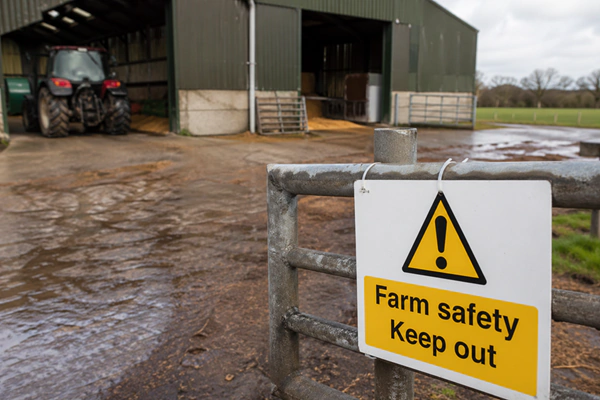
Farmland surrounds Tiverton, and agricultural work plays a significant role in the local economy. From livestock handling to machine operation, farm environments combine physical labour with changing outdoor conditions. While this type of work is often routine for those involved, the level of risk can vary significantly depending on the task being carried out.
When an accident occurs on a farm, it is not enough to look at the injury alone. The context, the level of risk involved, and the systems in place all play a role in determining responsibility. Knowing the assessment process for various agricultural accidents is crucial for determining your position.
Low-level but common risks on farms
Some of the most frequent accidents in agricultural settings involve lower-level hazards that are part of everyday farm activity. These include slips, trips, and falls caused by uneven terrain, mud, wet surfaces, or poorly maintained walkways.
For example, a worker walking through a farmyard in Tiverton may slip on a patch of mud mixed with animal waste near a frequently used pathway. While this type of surface may seem expected in a rural environment, the situation changes if the area is regularly used and has not been managed to reduce risk.
If pathways are not maintained or cleared where reasonably possible, or if safer routes are not provided, responsibility may arise. Even in environments that anticipate some level of hazard, we still have a duty to minimise avoidable danger.
Operational risks linked to systems and procedures
A step above everyday hazards are risks that arise from how work is organised. These often involve procedures, training, and supervision rather than just the environment.
Consider a situation where a worker is asked to operate equipment without proper instruction. In a Tiverton farming setting, this might involve using a mechanical loader or handling tools that require specific training. If an accident occurs because the worker was not adequately prepared, the focus shifts away from the individual and towards the system in place.
Operational risks are often preventable through:
- Proper training before tasks are carried out
- Clear instructions and supervision
- Regular checks to ensure safe working practices
When these elements are missing, the likelihood of an incident increases, and responsibility is more likely to be established.
High-risk incidents involving machinery and livestock
At the highest level, agricultural work involves significant risks from heavy machinery and animal handling. These situations carry the potential for serious injury and therefore require strict safety measures.
A common example in Tiverton would be an incident involving farm machinery such as tractors or automated equipment. If machinery is not properly maintained, or if safety guards are missing or defective, the consequences can be severe.
Similarly, failure to handle animals in a controlled or predictable manner can lead to livestock-related incidents. If proper enclosures, barriers, or handling procedures are not in place, a worker or visitor may sustain injuries.
In these higher-risk scenarios, expectations are significantly higher. There is an increased responsibility to ensure that all reasonable precautions have been taken to prevent harm.
Common agricultural hazards across risk levels
While risks vary in severity, certain hazards appear consistently across agricultural settings in Tiverton.
- Heavy machinery and moving equipment
- Livestock and animal handling risks
- Exposure to chemicals or hazardous substances
- Uneven terrain, mud and environmental conditions
These hazards highlight how agricultural work combines multiple risk factors, each of which must be managed appropriately.
How responsibility changes depending on the level of risk
The level of risk involved in an activity directly affects how responsibility is assessed. If not properly managed, lower-level risks can still result in valid claims, while higher-risk activities are subject to stricter expectations.
For example, a minor slip in a muddy area may be considered differently depending on whether it was reasonably maintained. In contrast, an injury involving machinery will require closer scrutiny of the safety systems, maintenance records, and training procedures.
This layered approach means that not all accidents are treated equally. The more serious the potential risk, the greater the expectation that preventative measures are in place.
What determines your legal position after a farm accident?
Your position following an agricultural accident depends on a combination of factors rather than a single event. These include:
- The type of activity being carried out
- The level of risk involved
- The safety measures in place at the time
- Whether the situation could reasonably have been prevented
For instance, if a worker in Tiverton is injured while carrying out a task they were not trained for, this may indicate a failure in workplace procedures. If the same task had been carried out with proper training and safeguards, the outcome may have been assessed differently.
This is why each case must be examined in context, rather than judged purely on the fact that an accident occurred.
When to seek guidance after an agricultural accident
When interpreting an accident, a detailed review of the situation often proves beneficial. Agricultural environments are complex, and the line between expected risk and preventable danger is not always obvious.
Marley Solicitors can assess the circumstances of a farm or agricultural accident in Tiverton, taking into account the level of risk, the systems in place and how responsibility is likely to be interpreted. This allows for a clearer understanding of whether the situation may support a claim based on the available evidence.
Final thoughts on farm accidents in Tiverton
Farm and agricultural accidents are not all the same. The level of risk involved in each situation plays a central role in how responsibility is assessed and what options may be available afterwards.
From everyday hazards to high-risk machinery incidents, the key question is always whether reasonable steps were taken to manage the danger. By looking at the situation through this layered perspective, it becomes easier to understand your position and decide what to do next.