

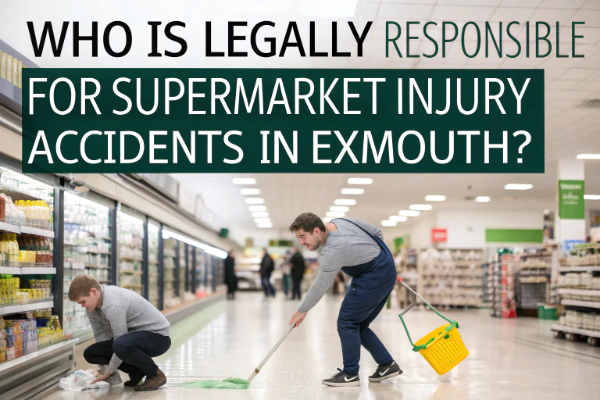
After a supermarket accident, most people focus on the injury itself. Only later does a more complicated question arise. Who was actually responsible? In Exmouth, supermarket injury claims often stall because people assume responsibility must be obvious before anything can happen.
In reality, liability in supermarket accidents is assessed through systems, procedures, and evidence rather than assumptions about blame. Understanding how responsibility is determined can help you decide whether pursuing a claim is realistic.
Why responsibility is not always clear
Supermarkets are busy environments with multiple people and processes operating at the same time. Staff restock shelves, cleaning teams work continuously throughout the day, deliveries arrive and depart, and customers move around the store constantly.
Because of this, safety hazards may be created by different sources. A customer, a delivery issue, or a leaking unit could cause a spill. Items may fall because of poor stacking or customer handling. Despite this, responsibility often rests with the supermarket itself, not the individual who caused the immediate hazard.
The law focuses on who had control of the environment and the duty to manage risks.
The supermarket’s legal duty of care
Supermarkets owe a duty of care to customers to take reasonable steps to keep premises safe. This duty applies regardless of how busy the store is or how frequently hazards arise.
Regular inspections, good cleaning systems, clear warning signs, proper staff training, and quick responses to known risks are all reasonable steps. A supermarket does not need to prevent every accident, but it must show that it had systems in place to reduce foreseeable risks.
If these systems were missing, poorly followed, or ineffective, liability may arise.
What if a third party caused the hazard?
A common misunderstanding is that supermarkets are not responsible if someone else caused the danger. For example, a customer spills a drink or an external contractor leaves a floor wet.
In practice, the supermarket may still be liable if it failed to identify and address the hazard within a reasonable time. Claims often focus on inspection routines and response times rather than on who caused the spillage.
This is why internal records and CCTV footage are often central to supermarket injury claims.
When staff actions are involved
If a member of staff caused or failed to address a hazard while carrying out their duties, responsibility usually lies with the supermarket as the employer.
Customers are not expected to pursue individual employees. Claims are typically made against the supermarket’s public liability insurance, which exists specifically to cover these situations.
Situations where liability may be disputed
Not every supermarket accident results in liability. Disputes may arise where a hazard developed very suddenly and staff had no reasonable opportunity to address it.
The proper placement and visibility of clear warning signs, barriers, or cordons can also influence liability. In these cases, responsibility may be reduced or removed entirely.
Each situation depends on evidence rather than assumptions.
How liability is proven in practice
Supermarket liability claims rely heavily on evidence. CCTV footage can show how long a hazard existed and whether staff passed it without acting. Cleaning logs and inspection records help demonstrate whether safety systems were followed.
Photographs taken at the scene and prompt reporting of the incident can also strengthen a claim. In Exmouth, CCTV footage is often overwritten within a short period, which is why early advice can be important.
What happens if liability is established
If liability is accepted, compensation may be paid to reflect the injury and its impact. This can include pain and suffering, loss of earnings, medical expenses, travel costs, and any ongoing support required.
Most supermarket injury claims are resolved through negotiation rather than court proceedings. The process is usually handled by insurers rather than directly by the supermarket.
Time limits you need to be aware of
Supermarket injury claims must usually be started within three years of the accident. Delays can make claims harder, particularly if evidence is lost or records are no longer available.
Seeking advice early does not commit you to making a claim, but it helps protect your options.
How Marley Solicitors can help
Marley Solicitors advises clients in Exmouth and across Devon who have been injured in supermarkets and other public places. We can assess who may be legally responsible, explain how liability is determined, and guide you through your options clearly and realistically.
Our focus is on evidence, practicality, and helping you decide whether pursuing a claim makes sense.
Understanding responsibility before deciding
If you were injured in a supermarket in Exmouth and are unsure who may be responsible, understanding how liability works can bring clarity. Many people delay action simply because responsibility feels unclear.
Clear guidance early on can help you make an informed decision and avoid unnecessary uncertainty.